

Geothermal Engineering's Cornwall plant enters commercial production
After nearly two decades of development and £46m in expenditure, Britain's first deep geothermal power plant has been switched on in Cornwall, marking a symbolically significant moment for the country's renewable energy mix.
The United Downs plant, operated by Geothermal Engineering Ltd (GEL) near Redruth, has been almost 20 years in the making.
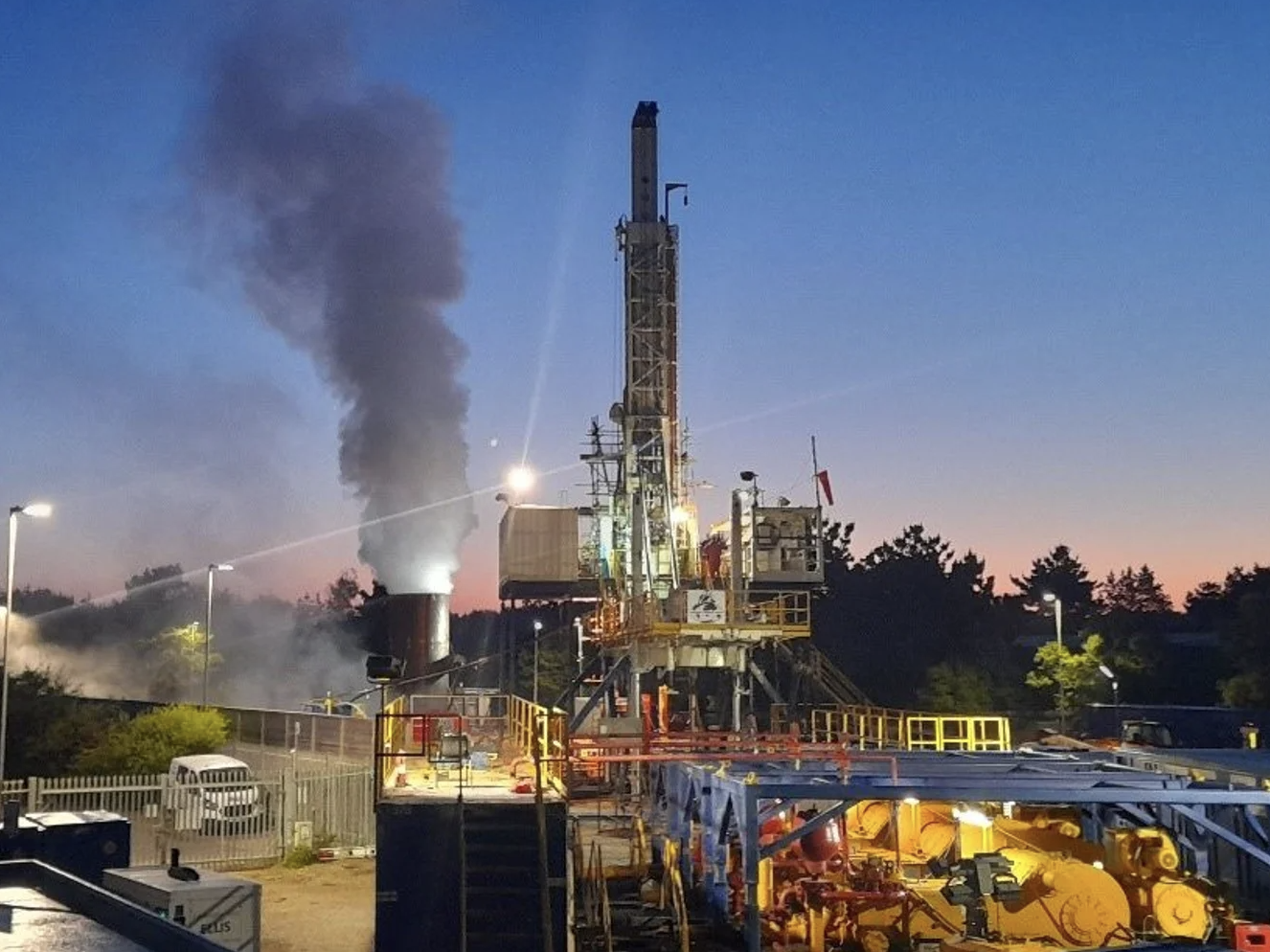
The United Downs power plant in Cornwall is the UK's first geothermal project. Image: GEL
Ryan Law, CEO of GEL, is candid about the journey to get here. "To finally reach this point is exciting – and a bit of a relief," he says.
The plant works by circulating water through fractures in granite rock some three miles below the surface, where temperatures reach close to 200°C.
These geological conditions are not that common in the UK. In most of the country, it is generally the case that drilling down a kilometre leads to a 20°C rise in temperatures.
However, the granite on which Cornwall rests is better at retaining heat, meaning that temperatures rise by about 40°C for every kilometre drilled.
Once the hole has been bored, superheated water from its lowest point is pumped to the surface, where steam drives a turbine before the cooled water – now at around 50°C – is re-injected into the fault line to be reheated, completing the cycle.
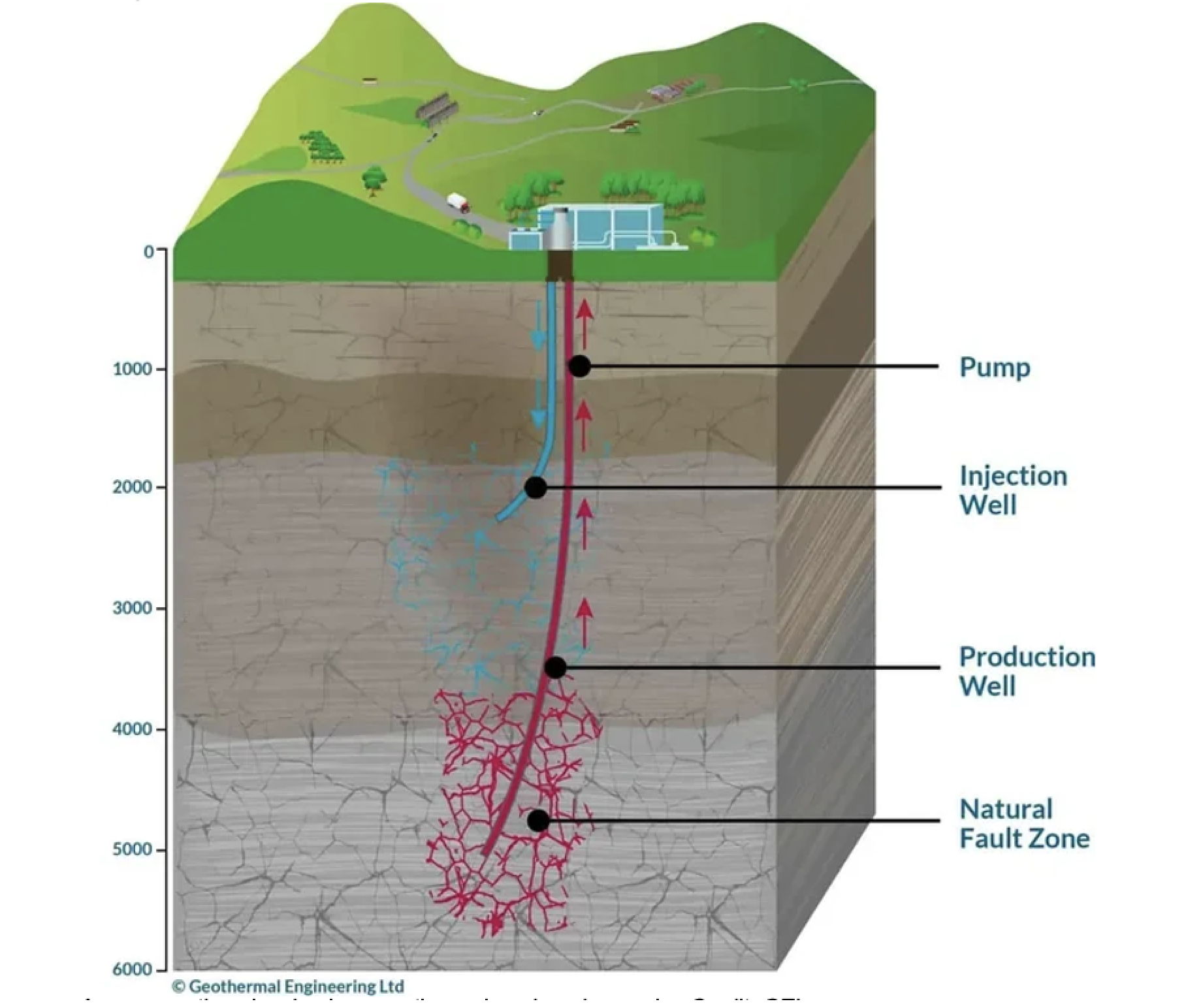
A cross-section showing how geothermal engineering works. Image: GEL
The electricity generated has been sold to Octopus Energy, which will supply it via the National Grid to meet the needs of up to 10,000 homes.

Ryan Law, CEO of GEL (left) and Anne Murrell
Unlike wind and solar, geothermal generation is continuous – an attribute that Ryan Law stresses is central to its value proposition.
"Unlike other renewable sources like wind and solar we are constantly on, 24/7 electricity," he says, adding that the absence of fuel costs means there are no price fluctuations of the kind seen with gas.
Global investment in deep geothermal electricity has grown 80% year-on-year since 2018, driven in part by the energy demands of data centres operated by the likes of Google, Meta and Microsoft.
It is a market dynamic that industry body Geothermal UK believes should sharpen the government's focus.
Anne Murrell, Head of Geothermal UK, argues that the sector remains under-supported at a policy level.
"The challenges we have include investment, and to unlock investment and increase investor confidence, we need a supportive government policy framework – geothermal needs to be recognised by government as a key part of our energy strategy," she explains.
Perhaps as significant as the electricity output is the plant's secondary function: lithium extraction.
The mineral-rich water drawn from the Porthtowan Fault Zone contains lithium carbonate, a critical material in the production of rechargeable batteries.
Initially, the site will produce around 100 tonnes of lithium annually which is enough for 1,400 electric vehicles, though GEL says it plans to scale this to 18,000 tonnes per year within a decade, which could supply roughly 250,000 EVs annually.
The UK government contributed £1.6 million – covering half the cost – of the initial lithium extraction facility.
The British Geological Survey has described the plant as a "major step forward" for geothermal but has also noted that high drilling costs make replication difficult.
Deep geothermal is also technically feasible in Scotland and the north-east of England, though there are currently no approved plans for either region.
China currently processes more than 60% of the world's lithium, and domestic production at any meaningful scale would represent a notable shift in supply chain exposure for British battery manufacturers.
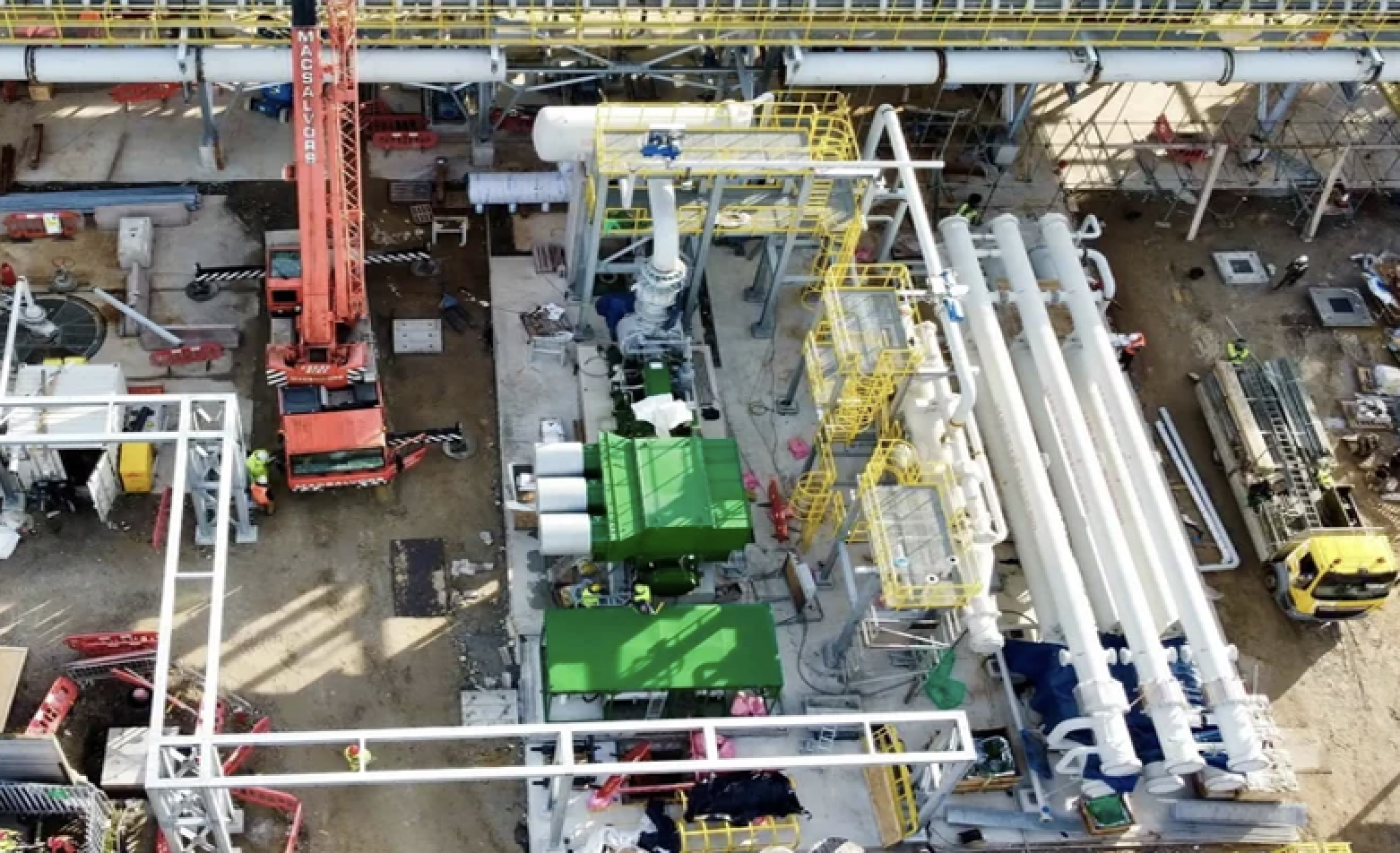
The site in Cornwall under construction. Credit: GEL
GEL has two further Cornwall sites in development, though one has been initially refused planning permission on environmental grounds – a decision the company is appealing.
The £46 million spent so far was funded through private investors and £14 million from the European Development Fund, a source of financing that is no longer available to UK projects following Brexit.
In a separate development, Aberdeen has commenced a significant phase in its journey towards adopting renewable heat sources, with the installation of underground sensors across the city to evaluate its geothermal energy potential.
This initiative, known as the Aberdeen Geothermal Feasibility Pilot (AGFP), is spearheaded by the University of Aberdeen and represents a crucial step in developing low-carbon heating solutions for the region.
The project involves burying approximately 100 small ‘seismic nodes’ in green spaces throughout Aberdeen, spanning areas from Bridge of Don to Nigg and extending into the city centre. These compact devices, measuring roughly 10cm x 10cm x 30cm, are designed to record natural vibrations from environmental factors such as wind, waves, and traffic over a period of one to two months.
The data collected from these nodes will be instrumental in generating a comprehensive 3D map of the granite and other geological structures up to 5 kilometres beneath the city’s surface. This detailed subsurface imaging is vital for identifying optimal locations where geothermal heating technology could be most effectively implemented.
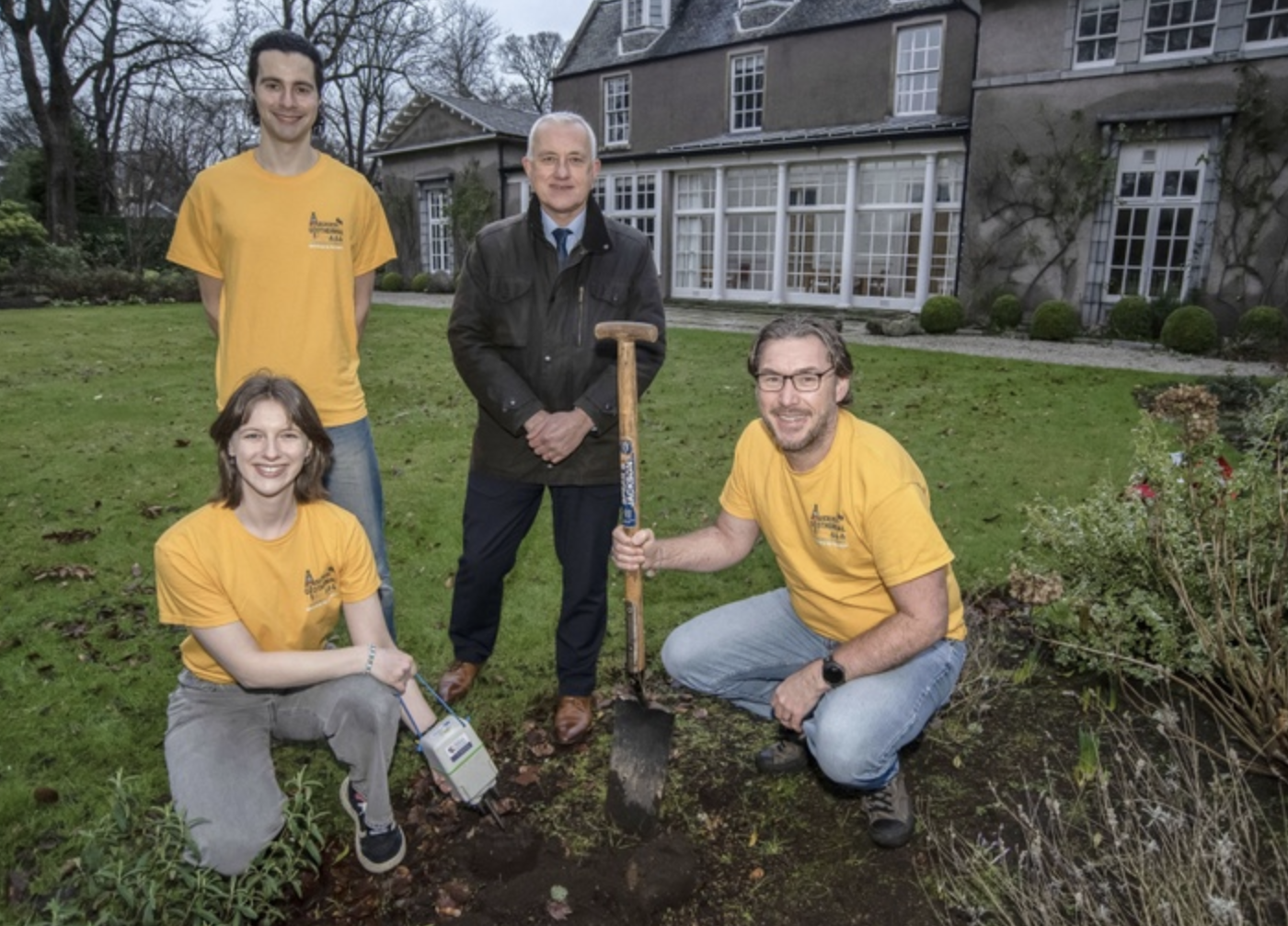
Technician lona Copley, researcher Tristan Roberts, University of Aberdeen Principal Professor Peter Edwards, and Dr David Cornwell, AGFP co-lead burying the sensors. (Photo: University of Aberdeen)
Dr Amy Gilligan, a researcher associated with the AGFP, highlighted the importance of this initial stage. She stated: “This marks the beginning of an exciting stage of the project. By placing these small sensors in the ground, we can safely and quietly listen to natural vibrations and build a picture of the rocks deep below Aberdeen.” The use of seismic nodes is particularly advantageous for urban geothermal exploration due to their minimal impact and effectiveness in noisy environments.
The AGFP, funded by a £1 million public grant from UK Research and Innovation (UKRI), is an ambitious collaboration with a broad consortium of partners. This includes NHS Grampian, Aberdeen City Council, Aberdeen Heat and Power, Robert Gordon University, the British Geological Survey, and various industry partners.