

The Government’s 10-year Infrastructure Strategy commits to a more spatial approach to infrastructure planning, with better coordination across sectors and between national, regional and local levels.
As part of this approach, the government’s wider planning reforms will extend strategic planning across England through Spatial Development Strategies, and support faster preparation and adoption of Local Area Energy Plans (LAEPs).

LAEPs are led by local government and developed collaboratively with defined stakeholders. The results are a fully costed, spatial plan that identifies the change needed to the local energy system and built environment, detailing ‘what, where and when and by whom’. LAEP sets out the total costs, changes in energy use and emissions, and sets these out over incremental time periods to meet the 2030 target of a 68% reduction in emissions, and the 2035 target of a 78% reduction in emissions, and net zero by 2050.
Planners and policymakers need to bring together large amounts of data to understand how proposed growth and changes in land use interact with infrastructure systems, including energy, water, transport and community services, as well as the environment, and NISTA have unveiled a tool to help.
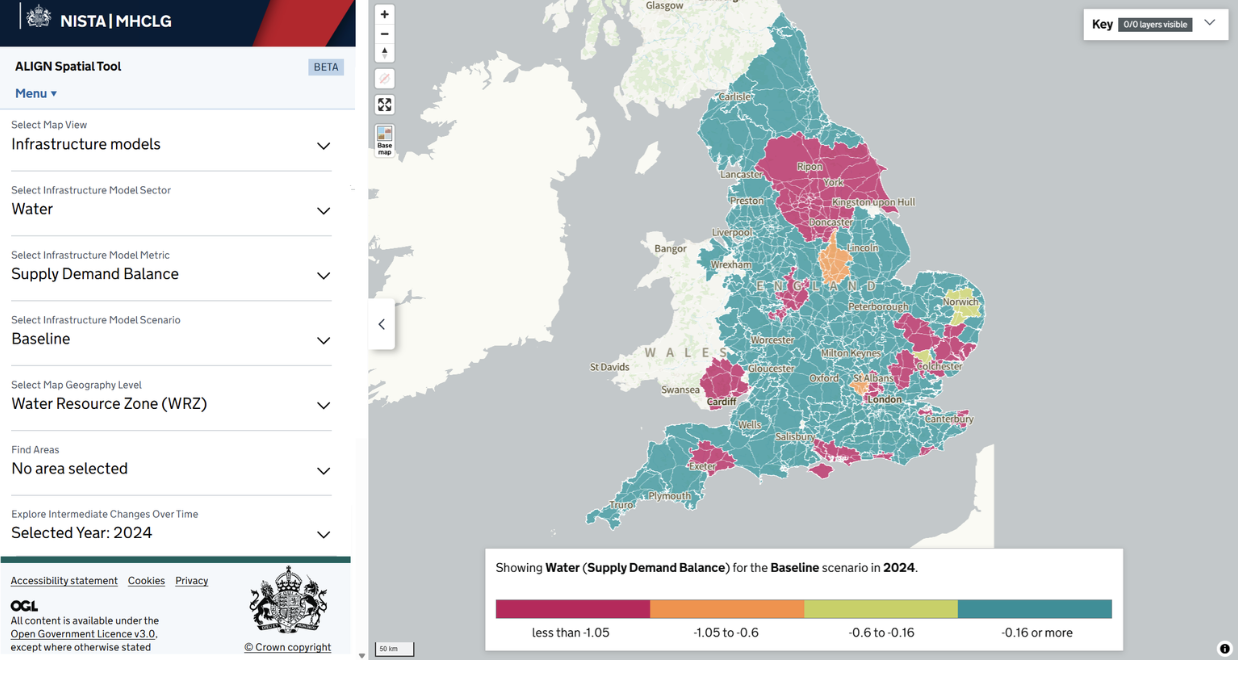
The ALIGN tool. Illustrative map only with sample data. Spatial patterns are shown for demonstration purposes only and should not be used for operational, planning or decision-making purposes. Image: Gov.UK
ALIGN is a new national infrastructure spatial system that brings together data, and models, including AI, to identify local infrastructure needs and constraints for numerous housing, industrial growth and land use scenarios.
Developed by a cross-government team led by the National Infrastructure and Service Transformation Authority (NISTA), ALIGN supports both plan-making reform and delivery of the government’s 10-year Infrastructure Strategy.
ALIGN has two primary use cases at different levels of government:
ALIGN is providing central government with spatial evidence to inform policy development and decision-making. It is also being used to provide a rapid and consistent cross-sector assessment of infrastructure gaps, risks and constraints at locations identified as priorities for significant growth and housing. This will help local partners, government departments and infrastructure providers to develop a shared understanding of where further analysis, options development or coordination may be needed.
At the local and strategic level, in collaboration with the Digital Planning Programme, ALIGN will help planning authorities to prepare spatial development strategies and local plans. By providing consistent infrastructure capacity metrics for various growth and delivery scenarios, the tool can assess the implications of development choices and infrastructure delivery options at a local level. The tool can reduce reliance on multiple commissioned studies, support planning across administrative boundaries and help authorities develop evidence-based plans more efficiently.
Importantly, ALIGN doesn’t make planning decisions. It provides complementary evidence to local insights and knowledge to help coordinate numerous stakeholders to test options, understand trade-offs and make informed judgements based on local circumstances.

Becky Wood
“With programmes like its Northern Growth Strategy and the Oxford-Cambridge corridor, the government is recognising the need for a new approach to unlocking growth in every region of the country. The 10-Year Strategy is central to that.
NISTA has created a new Spatial Planning team to work across government to coordinate infrastructure with other policies and programmes that influence how places function.
Our new ALIGN tool is already helping departments and regional and local government to assess local infrastructure needs and better understand where infrastructure can best support economic growth”, said NISTA CEO, Becky Wood.
SP Electricity North West (SP ENW) has become the latest electricity network operator to adopt a standardised template, following the leadership shown by UK Power Networks’ Distribution System Operator (DSO). The standardised template enables local authorities to share their Local Area Energy Planning (LAEP) data with utilities in a single, consistent format. The move expands a national approach that is improving how local energy systems are planned, for the benefit of customers and communities.
Lynne McDonald, head of local net zero at UK Power Networks DSO, said:
“From the outset, our aim was to make Local Area Energy Planning simpler and more effective for councils, while delivering better outcomes for customers.
By leading the development of a common, practical template, we’ve helped remove unnecessary complexity and ensured local plans can directly inform network investment.
Seeing SPENW fast follow this approach shows the value of setting a clear standard that supports local authorities and helps all networks plan smarter, more efficient systems that keep costs down and reliability high for customers. I’m excited to see who joins us next in our mission to be customer-first in the sharing of local data.”

Lynne McDonald and Christos Kaloudas
Christos Kaloudas, capacity strategy lead manager at SP ENW, said:
“At SP Electricity North West, we continuously improve and enhance our support to local authorities on their decarbonisation journey and economic growth plans.
“Listening to our stakeholders needs, we’re already delivering training to various local authorities within our region and supporting them with their energy planning. The Local Authority Common Ask further enhances and standardises our offerings to local authorities in the North West.
SP ENW’s decision to adopt this approach marks an important step in scaling the benefits of this work further across the UK, ensuring more councils can plan confidently and efficiently across network boundaries. Better alignment between networks means better‑informed and more coordinated investment in local electricity infrastructure for customers”.