

Social housing tenants living in flats could lower bills by generating their own energy and be paid for helping to balance Britain's electricity grid, under a new scheme explored by housing associations and local authorities at an industry event.

Warm reception: E.ON and Allume consult with social landlords. Image: E.ON
FlatSave, a UK-first collaboration between E.ON Next and Allume, turns a block of flats into a shared energy asset, helping residents cut bills and earn money from the energy their building generates and stores. A single rooftop solar array and communal battery can serve every flat in the building, reducing bills for tenants.
The battery charges when electricity is cheapest and supports the grid when demand peaks, with residents receiving a guaranteed annual payment in return. By using energy when it is cheaper and making stored power available when the grid needs it most, FlatSave can deliver value both to individual households and the wider energy system.
The event comes as typical household energy bills are forecast to pass £2,000 a year, and amidst growing debate ahead of the Budget over government funding for social housing energy upgrades.
More than five million households in England and Wales live in flats, including almost half of the country’s social housing stock. Allume estimates that fewer than 1% of these households currently benefit from rooftop solar. FlatSave addresses this barrier directly, giving residents in flats the same opportunity to generate cheaper, cleaner energy as those living in houses.
FlatSave combines Allume's SolShare technology, which equitably distributes solar and battery power to every flat through its existing meter, with E.ON Next’s expertise in grid flexibility. No equipment is needed inside homes and all residents can see the benefit regardless of their chosen supplier.
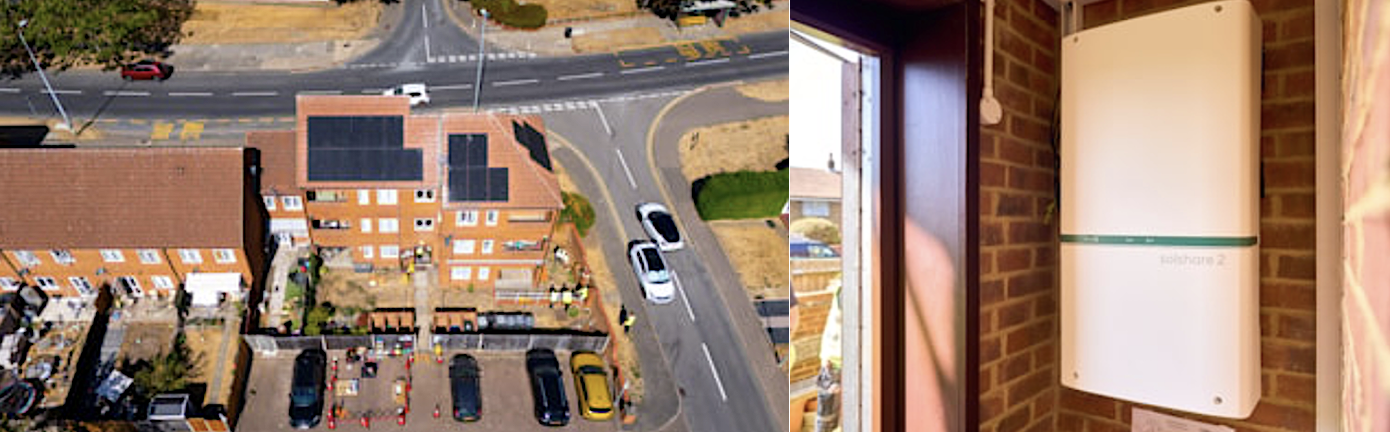
Allume’s SolShare technology is installed at Peabody’s Harper Court premises in Stevenage Images: E.ON
The first FlatSave system was installed with Peabody Homes at Harper Court in Stevenage, with more FlatSave projects planned across the country this year.
Jack Taylor, General Manager Europe at Allume Energy, said: "The housing providers we work closely with want practical ways to bring cleaner, cheaper power to their homes without disrupting their residents. Generating solar power, storing that energy in batteries and trading with the grid is one of the most practical and impactful ways we can drive down bills for good."
The UK’s first use of the FlatSave solar+battery+flexibility technology has been completed at Harper Court in Stevenage, Hertfordshire, alongside Peabody Housing and six residents.
The 15kW solar and 18kWh battery will generate and store electricity that can be shared across the six homes and into the local energy grid when needed. All six residents receive the free electricity from the solar generation on their roof. Residents can also sign up for the battery flexibility programme.
Lorraine, a resident at Harper Court, said: “Having extra money in my bank has been brilliant. Seeing my bills drop has brought real peace of mind. With the panels and FlatSave, I no longer have to constantly watch my energy use or switch devices on and off, which has made my life so much easier.”
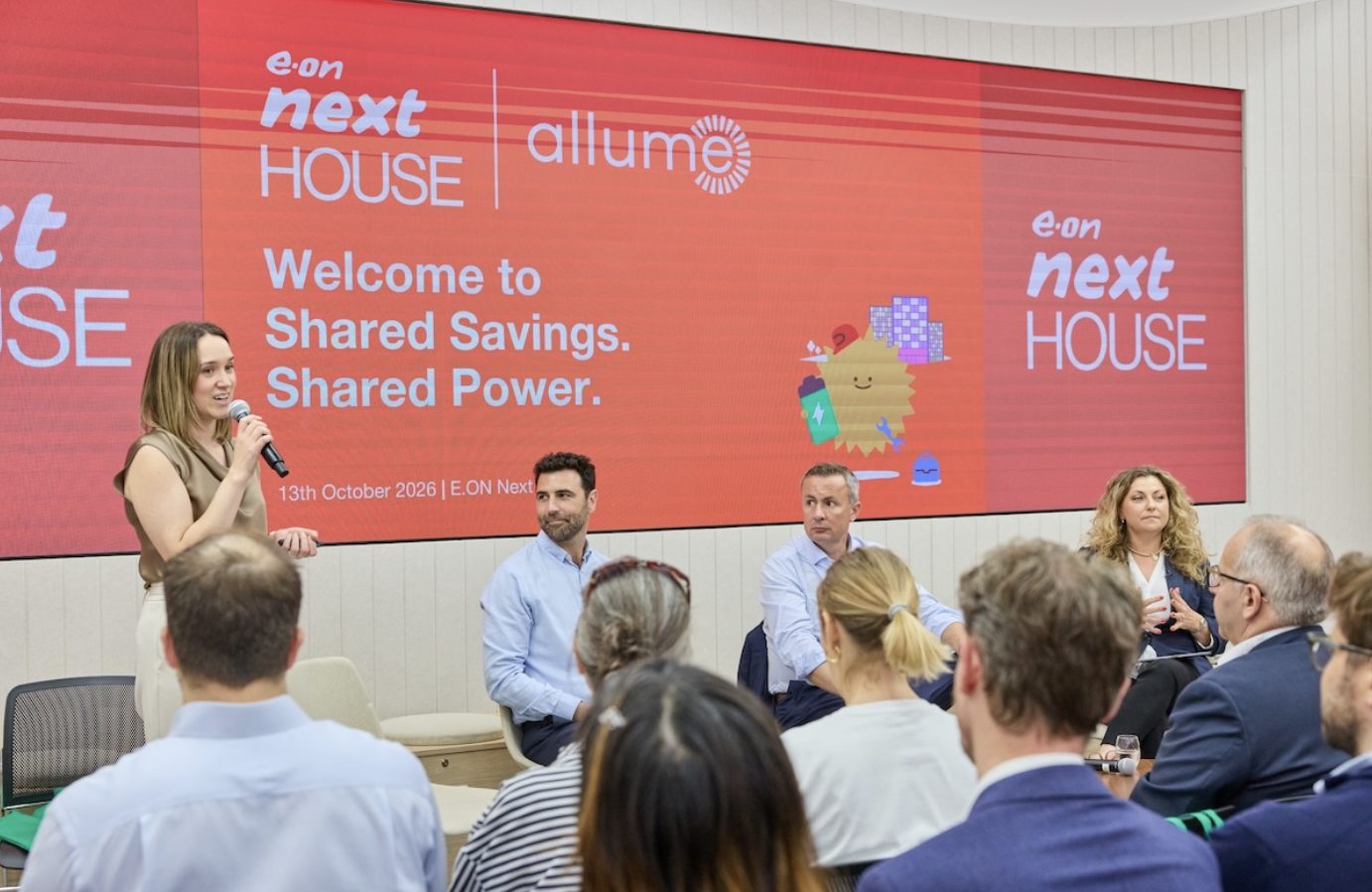
Michelle Hughes, Allume Partnership Lead E.ON Next, Jack Taylor, General Manager Europe at Allume and Chris Norbury, CEO of E.ON UK and Ramona Vlasiu, Chief Operating Officer at E.ON Next. Image: E.ON
Speaking at the event in London, Ramona Vlasiu, Chief Operating Officer at E.ON Next, said:
“People living in flats have missed out on the benefits of the energy transition for too long. FlatSave is changing that, combining Allume’s technology with E.ON Next’s scale and flexible energy solutions to help residents lower their bills without needing to switch supplier. That’s what making new energy work for everyone looks like.
“For residents like Lorraine, this isn’t about technology for technology’s sake, it means no longer having to choose between heating and cooking. We are looking to take solutions like this to scale, and my message to housing associations and councils is simple: come and talk to us.”
Reflecting on the install at the event, Rashida Kutubu, Senior Retrofit Manager at Peabody, said:
“Before SolShare and FlatSave, we didn’t know how to bring solar to our blocks of flats. SolShare distributes energy across every flat based on what each household needs.
With the addition of grid flexibility through FlatSave, we’re not just reducing bills, we’re putting money back in their pockets too.”
SolShare’s proven track record has already secured high-profile government and industry backing, further mitigating risk for social landlords. SolShare is prominently featured as a case study in Great British Energy’s Local Power Plan and detailed as a Type 1 (shared behind-the-meter) solution in the DESNZ Community Batteries Call for Evidence. Furthermore, Allume’s work has been highlighted in a small-scale solar report by the Parliamentary Office of Science and Technology (POST) and featured as a RISE ‘Retrofit Success Story’, with Allume actively leading RISE Masterclasses on solar PV for flats.
The 15kW solar and 18kWh battery will generate and store electricity that can be shared across the six homes and into the local energy grid when needed. All six residents receive the free electricity from the solar generation on their roof. Residents can also sign up for the battery flexibility programme.
Participating E.ON Next customers will receive up to £160 in payments from the battery and participating residents with other energy suppliers can receive up to £80 in payments from the battery.
Future installs are already planned for later this year at housing association properties around the country.
The system removes the technical and ownership barriers that have long kept many residents in flats from accessing cheaper, cleaner energy. It works ‘behind the meter’ where energy is generated and consumed in the same place, meaning residents can stay with their existing energy provider and no external changes are needed by suppliers or network companies.