

Building pylons in Wales could be a thing of the past, with the country's ministers instead wanting to bury energy cables underground.
The Welsh government has announced plans to ban the use of traditional steel pylons to support electricity lines over which it has control.
Plans for a network of pylons in the Towy Valley have faced a fierce local backlash with local Plaid Cymru politicians speaking out against the proposals.
Plaid ministers favour burying cables underground instead.
Prohibiting the use of large steel lattice pylons for new lines up to 132 kilovolts was a Plaid Cymru manifesto pledge before May's Senedd election.
Launching a consultation on its policy, the Welsh government said undergrounding electricity circuits could "reduce the visual impact of electricity infrastructure, helping to protect landscapes and local amenity".
It also said that burying cables could make them less vulnerable to severe weather and could reduce the potential impact on birds and other wildlife but acknowledged undergrounding was "generally considered more expensive to install and maintain and could create construction impacts during installation".
The government's policy would allow for wooden poles or "equivalent, less intrusive infrastructure" to be used to support overhead cables where undergrounding isn't feasible.
Developer Green Gen Cymru has plans to build three major power line routes connecting onshore wind farms planned by its sister company Bute Energy and has proposed three pylon routes from mid Wales across to Shropshire, south-west Wales to Ceredigion, but it has faced considerable opposition in certain communities.
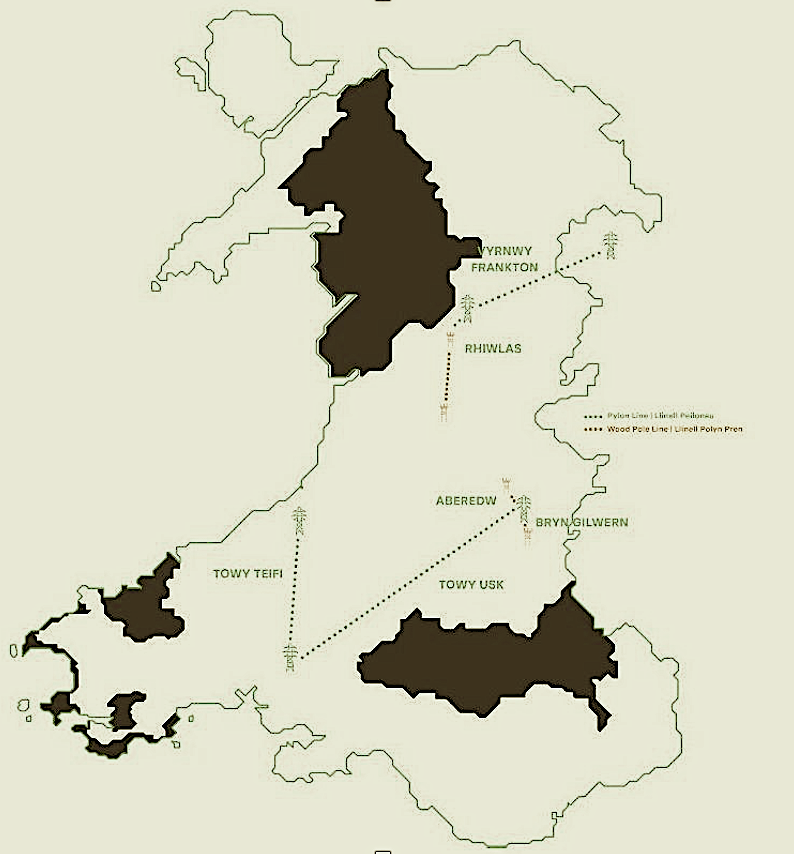
Image: Green Gen Cymru
In a bid to address concerns, Green Gen recently unveiled a "slim and compact" 22 metre (72ft) pylon, designed "with the Welsh landscape in mind".
The company has consistently said that undergrounding its cables would cost on average 4.5 times more than running them overhead.
That would mean an extra cost of £500m for the Towy Usk project between Carmarthenshire and Powys, according to Green Gen.
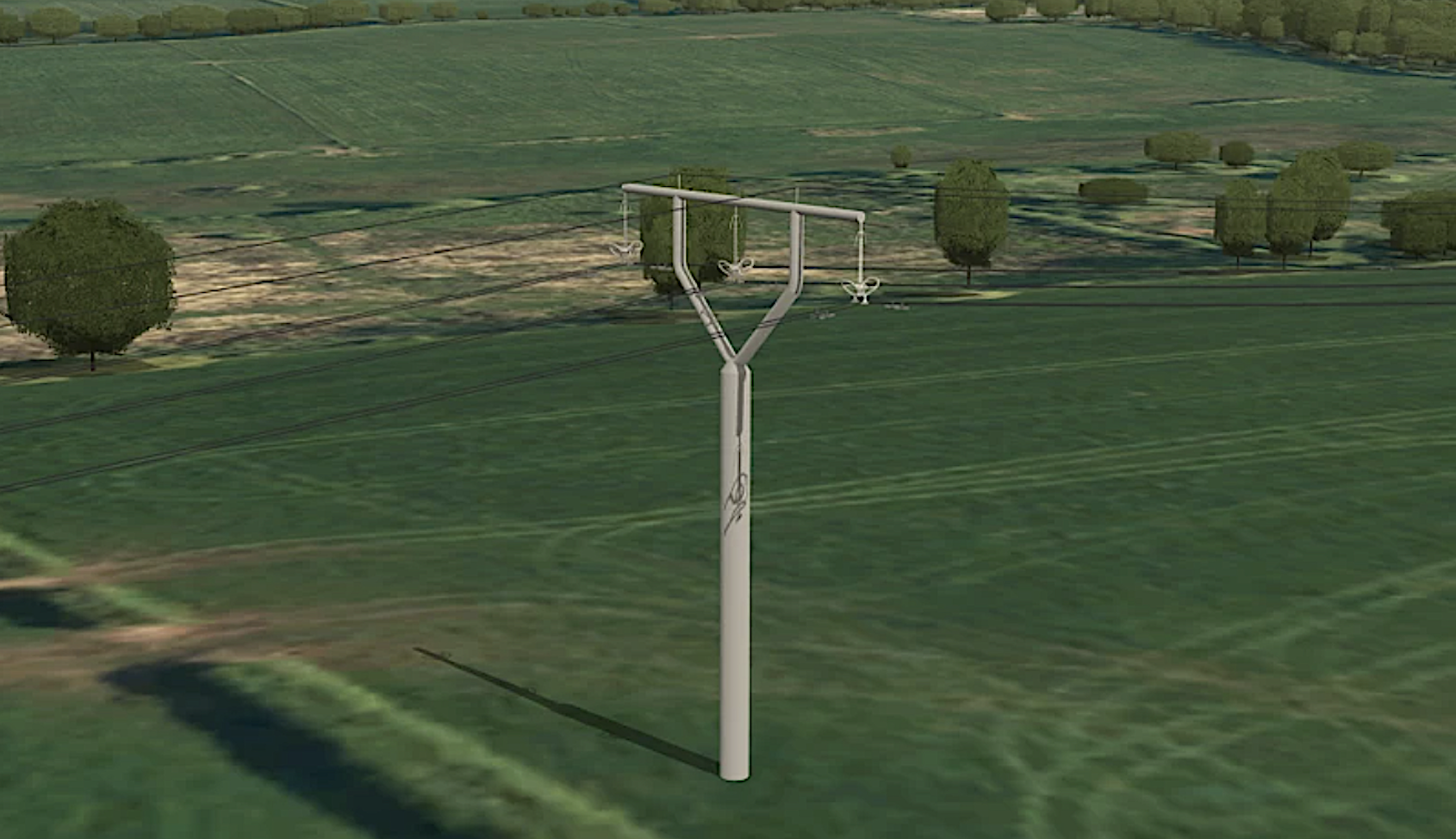
CGI of the proposed Welsh monopole Image: Green Gen Cymru
Dyfan Walters, a farmer in Llandovery who is also a member of Llandovery Pylon Group, called the announcement of the consultation “a positive day for us".

Dyfan Walters, (left) and Andrew Hardcastle
"We're fully supportive and understand that the infrastructure is required. Putting that underground means that there's less impact on agriculture, less impact on tourism.
"In a world where there's an ever-changing climate, having that resilience - having infrastructure placed underground - is a sensible way forward."
Adam Price
Welsh Energy Minister Adam Price said: "We know the necessary changes in the way energy is generated and used in Wales will require new grid infrastructure, however, we also know that new infrastructure can impact on the communities and the environment that hosts it.
"We want to see infrastructure that is sensitively designed to minimise impacts on the environment and the communities that host them, while offering the maximum benefits for Wales."
Andrew Hardcastle, executive director at Green Gen Cymru, said: "We welcome the Welsh government's consultation and its recognition of the importance of delivering the electricity infrastructure Wales needs in a way that is sensitive to our landscapes, environment and communities.
"Like all grid companies across the UK, we believe there is no one-size-fits-all solution to developing new electricity networks.
"Our approach is to use the right infrastructure in the right place, drawing on a range of technologies including underground cables, wooden poles and our recently announced lower-profile monopoles."
Welsh Labour's environment, rural affairs, energy and transport spokesperson, Vikki Howells said: "Burying cables can cost five times as much as overhead lines, making electric more expensive and decarbonisation more difficult."
She said the sensible position was choosing the right engineering solution for the right landscape and "undergrounding should absolutely remain available where landscape, environmental or other circumstances justify it".
The consultation will run until the new year..